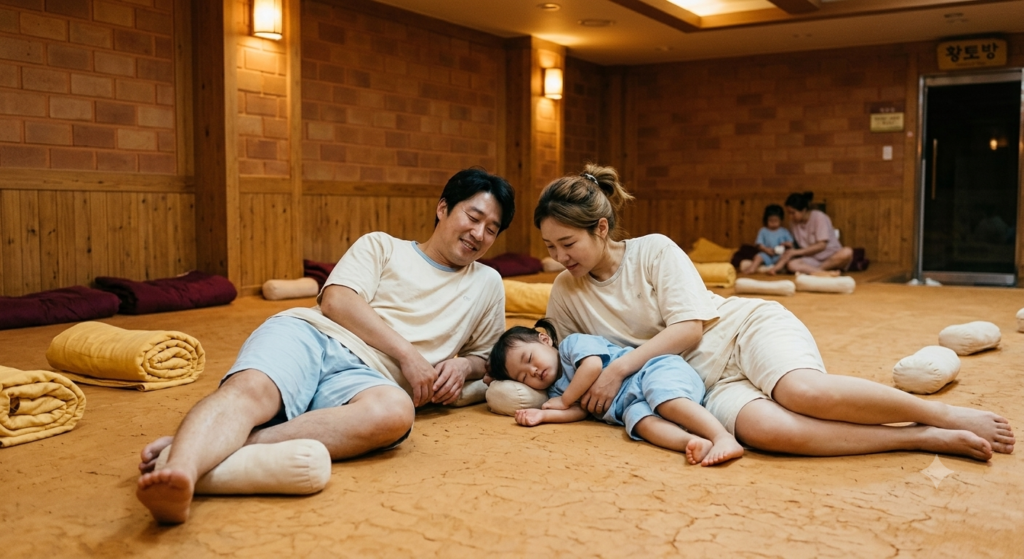
Last winter, my wife, our daughter, and I spent a Sunday afternoon at a jjimjilbang (찜질방) near our apartment in Yongin. Our daughter fell asleep on the heated ochre-clay floor within twenty minutes, my wife disappeared into the women’s bath section promising it would be “just a quick scrub,” and I found myself lying in the dry sauna room wondering how a bathhouse had somehow become our entire Sunday plan. That’s when it hit me: nobody in Korea treats a sauna as just a place to get clean.
Known as jjimjilbang (찜질방), Korean saunas are one part bathhouse, one part living room, and one part multi-generational hangout spot. Unlike the quiet, solitary spa culture I grew up with in the UK, a Korean sauna is loud, social, and often full of families like mine spending half a day there without ever stepping outside.
Hot, Cold, and Everything Between
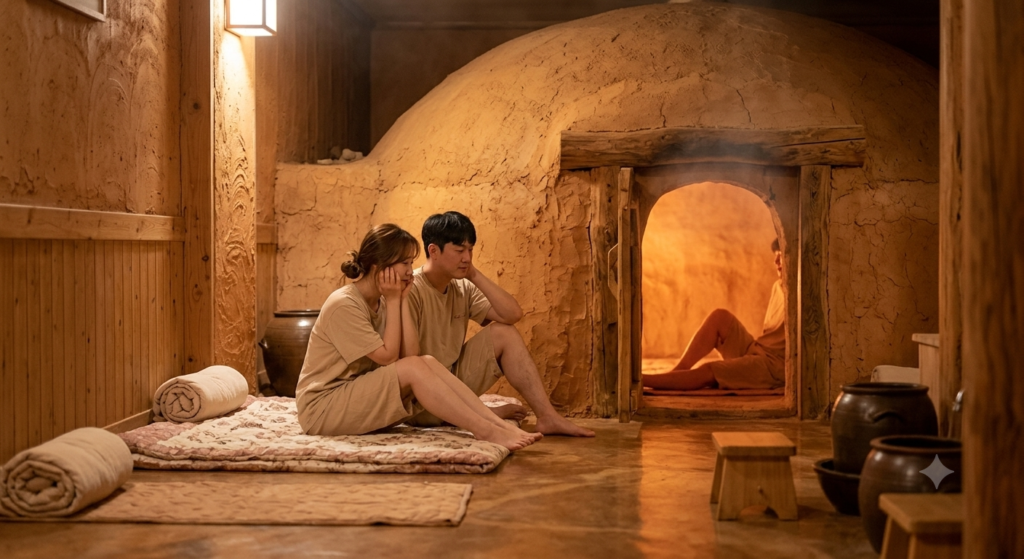
A typical jjimjilbang includes several heated rooms set at different temperatures — some lined with clay, salt, or charcoal, each said to help with something different — plus hot and cold pools and open common areas covered in heated floors. People move between them in a loose rotation: a few minutes in the hottest room, a quick plunge into the cold pool, then a long stretch lying flat on the warm floor staring at the ceiling. It looks unstructured, and it is. That’s kind of the point.
The Ritual of Semi (세신) — the Scrub Nobody Warns You About
The first time I sat down for semi (세신), the traditional Korean body scrub, I was not prepared for an ajumma in a black bra and matching underwear to remove what felt like an entire layer of skin using a coarse cotton mitt called an “Italy towel” (이태리타월). It’s intense, occasionally a little painful, and somehow one of the most satisfying twenty minutes you can spend in Korea. Afterward, your skin genuinely looks and feels different — and most Koreans treat it as a completely ordinary monthly errand, not an occasional spa luxury.
A Family Outing, Not a Solo Retreat
What struck me most, coming from the UK, was how social the whole experience is. Grandparents nap next to teenagers on the same heated floor. Parents order sikhye (식혜, a sweet rice drink) and gyeranchim (계란찜, steamed egg) from the sauna’s snack counter. Our daughter treated the entire building like an indoor playground with extra steam rooms. Nobody seemed to be in any hurry to leave.
What to Know Before Your First Visit
- Entry usually costs around 10,000–15,000 KRW and includes a set of shorts and a t-shirt for the common (mixed) areas.
- The bathing pools themselves are gender-separated, and yes — no swimsuits, no exceptions.
- Common areas like the heated rooms, sleeping rooms, and snack counters are mixed and require the shorts/t-shirt uniform.
- Many jjimjilbangs are open 24 hours, and some travelers use them as a cheap overnight stay between trains or flights.
- Semi (세신) is optional and usually paid separately, around 25,000–40,000 KRW.
Why It Feels Like an Actual Reset
The heat improves circulation. The cold plunge snaps the body back awake. The scrub physically removes a layer of built-up skin — and, somehow, a layer of stress with it. The rest areas force you to just lie down and do nothing, which is rarer than it should be. Put together, it’s less a beauty routine and more a full physical reset — one that most Koreans build into ordinary weekends rather than saving for a special occasion.
What This Says About Korean Wellness
Korean wellness culture, at least the version I’ve experienced living here, isn’t built around expensive products or elaborate self-care routines. It’s built around repetition — the same jjimjilbang trip every few weeks, the same scrub, the same slow afternoon on a heated floor. Rest isn’t something you schedule around your life here; it’s something built into it.
A Ritual That Goes Beyond Hygiene
If you’re visiting Korea, a jjimjilbang is one of the most authentic, least touristy things you can do for about the price of a movie ticket. And if you’re not near one, you can borrow a small piece of the ritual anywhere — a hot bath, a rough washcloth, and twenty minutes where you’re not allowed to look at your phone.
If you enjoyed this post, you might also like why Koreans take off their shoes at home — another everyday ritual most outsiders don’t expect — or how Koreans beat the summer heat without central AC, another example of how Korean daily life is built around small resets.
Inside The Haru Box
The Haru Box explores everyday life in Korea through small cultural details and daily habits. Written by David — Korean-born, raised in England, now living in Yongin, South Korea with his wife and daughter. These are the moments that make life in Korea feel real.