Last month, a colleague from our Seoul office got married, and I found myself at my desk holding a plain white envelope, doing math I didn’t expect to be doing at my age. Five years ago, I would have folded one 50,000 won bill into it and called it done. This time, I hesitated. A friend leaned over and said, “That’s not going to cover your seat anymore.” He wasn’t joking.
That sent me down a rabbit hole every foreigner in Korea eventually falls into: how much cash am I actually supposed to give? Not the textbook answer — the real one, for 2026, for weddings, for a baby’s first birthday, for a funeral. The old “one 50,000 won note settles it” rule doesn’t quite hold up anymore, and the reasons why say a lot about how this system actually works.
Why Cash Isn’t Really a “Gift” in Korea
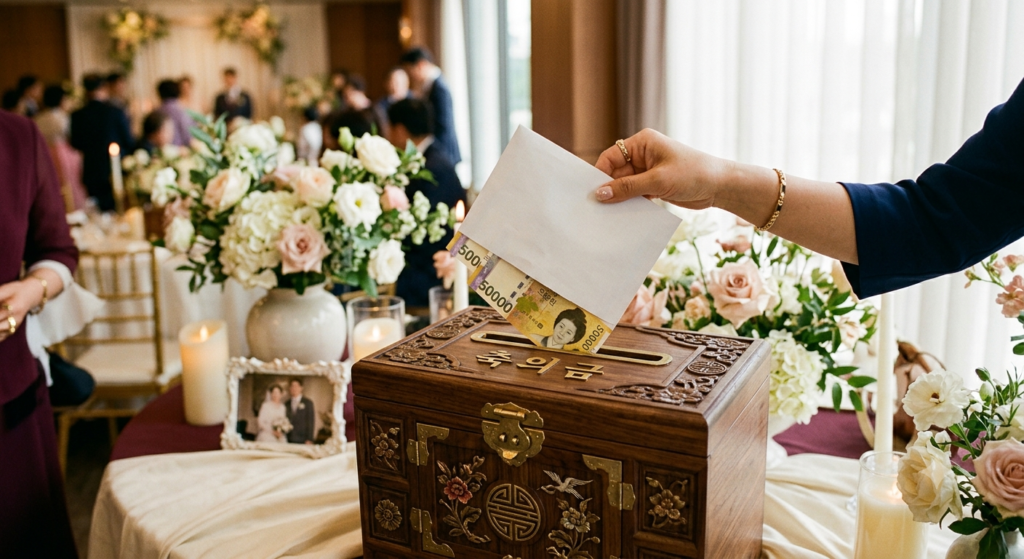
축의금 (chukuigeum) at weddings, 축하금 at doljanchi, 조의금 at funerals — these aren’t tips or donations. They’re a structured system of mutual obligation. You give what fits the relationship, and when your turn comes around, roughly the same amount comes back. It’s less gift-giving and more a long-running, unspoken ledger that Korean families and colleagues keep with each other for decades. Get the number wrong — too low, and it reads as disrespect. Too high, and it can feel like you’re buying a closeness that isn’t there yet.
Weddings: What 50,000 Won Actually Buys You Now
Here’s the number that changed things for me. National data collected in early 2026 puts the average wedding meal at 62,000 won for a buffet, 119,000 won for a plated course, and 55,000 won for a traditional set table — per person. Hotel weddings run even higher, often 100,000–150,000 won a head. That “standard” 50,000 won envelope doesn’t even cover the meal you’re about to eat, let alone the gift itself. It’s part of why Kakao Pay’s transaction data showed the average wedding gift crossed 100,000 won for the first time last year — roughly double what it was in 2019.
In practice: if you’re attending, 100,000 won is now the real floor for an acquaintance or coworker. If you’re close — old friends, coworkers you see daily — 100,000 to 200,000 won is normal, and couples attending together often round up to 150,000–200,000 won to cover both meals. If you can’t attend at all, 50,000 won is still the accepted, no-questions-asked amount. Showing up in spirit still counts, even without a seat.
Doljanchi: A Gentler Scale
A baby’s first birthday runs on softer numbers — partly because the meal is cheaper (usually 30,000–50,000 won a head at the buffet), and partly because a first birthday just doesn’t carry a wedding’s financial weight. Friends and junior colleagues typically give 50,000 to 100,000 won; close family and relatives go higher, 100,000 to 200,000 won. If you’re attending and eating, 50,000 won is the comfortable floor. And unlike weddings, doljanchi is one of the few occasions where cash isn’t mandatory — baby clothes, toys, or a small gold ring are all normal substitutes, and often more personal.
Funerals: A Completely Different Logic
조의금 trips up more foreigners than either of the above, because it runs on its own rules. Amounts are given in odd numbers — 30,000, 50,000, 70,000 won — since odd numbers are traditionally tied to life and growth, while even numbers are linked to death and closure. 100,000 won is the one even-numbered exception, treated as a “complete” number because it’s built from 3 and 7 combined. And never give 40,000 won — the number 4 sounds identical to the Korean word for “death” (사), and it’s avoided almost everywhere in Korean life, from hospital floor numbers to gift amounts.
For a coworker’s parent, 30,000 to 50,000 won is standard; if you were genuinely close, 50,000 to 100,000 won. For immediate family, the number jumps considerably — 200,000 to 500,000 won or more — since condolence money for close family is understood as helping shoulder the actual cost of the funeral, not just a gesture.
How to Actually Hand It Over
The mechanics matter almost as much as the number. Cash goes into a plain white envelope — for weddings and doljanchi, any clean envelope works, and pre-printed ones are sold at stationery shops and convenience stores near every wedding hall. For funerals, use a plain envelope, ideally the pre-printed “부의” (condolence) type sold at the funeral hall entrance. Write your full name on the back, bottom-left, so the family can track who gave what — this isn’t nosiness, it’s how the reciprocal system stays organized over the years. Use clean, non-crumpled bills if you can; a fresh note from an ATM is normal. Hand the envelope to the reception desk before you sit down, not directly to the bride, groom, or grieving family. These days, mobile transfer — often through Kakao Pay — has become an accepted substitute among close friends, especially if you can’t attend in person, though older relatives generally still expect the paper version.
The Bigger Picture
With our second daughter due here in Yongin next month, I’ve started seeing this from the other side too — watching how differently people show up for a colleague’s wedding versus a close friend’s, and realizing the range isn’t rudeness. It’s precision. Korean gift-giving culture doesn’t pretend a coworker you met six months ago and your closest friend from college deserve the same envelope. The amount is a quiet, honest signal of exactly how close you are, and everyone reads it that way without anyone saying it out loud. It’s blunter than Western etiquette usually allows — and once you stop resisting that bluntness, the math actually gets easier, not harder.
If there’s one thing I’d tell anyone new to this system: don’t default to whatever number felt right five years ago. Prices move, meal costs move, and the “safe” envelope moves with them. Check where you actually stand with the person, round appropriately, and you’ll rarely go wrong.
If you enjoyed this post, you might also like why every Korean baby gets a doljabi party — the celebration this cash-gift math applies to — or why a Korean wedding isn’t what you think, the tradition-packed event behind that envelope.
Inside The Haru Box
The Haru Box explores everyday life in Korea through small cultural details and daily habits. Written by David — Korean-born, raised in England, now living in Yongin, South Korea with his wife and daughter. These are the moments that make life in Korea feel real.