It was barely 8am and I was already sweating through my shirt on the walk from our apartment block to the parking garage in Yongin. My wife, seven months pregnant, had the air conditioning running before she’d even opened her eyes. My daughter, two years old, has her own tiny handheld fan clipped to her stroller — she doesn’t leave the house without it in July. Meanwhile, every time I check the news, it’s the same story out of Europe: record-breaking heat, hospitals overwhelmed, and millions of homes with no way to cool down at all.
That gap is what got me thinking. Korean summers are brutally hot and unbearably humid — but Koreans have spent decades building an entire culture, and an entire industry, around not suffering through it. Air conditioning here isn’t a luxury item you debate installing. It’s assumed, like running water. And when you step outside the range of a wall unit, there’s a gadget for that too.
Air Conditioning Isn’t Optional Here
In Korea, even a small one-room studio (원룸, wonrum) comes with a wall-mounted air conditioner as standard, not an upgrade. Apartment buildings are designed around it. Subways and buses run so cold in summer that Koreans joke about carrying a cardigan in July just to survive the commute — people call an overly air-conditioned bus a “refrigerator” (냉장고, naengjanggo) only half-jokingly. Local governments even open free public cooling centers called 무더위쉼터 (mudeowi swimteo, literally “heatwave shelters”) in community centers and senior halls during the worst of the season.
Samsung’s popular 무풍에어컨 (mupung eeokeon, “windless air conditioner”) line is a good example of how far the culture goes — it’s an air conditioner designed to cool a room evenly without blasting cold air directly at anyone, marketed specifically so babies and elderly parents aren’t sitting in a direct draft for eight hours a day. That kind of product only exists because air conditioning here isn’t something you turn on for an hour in the evening. It runs constantly, for months, and comfort engineering matters.
I’ve read that only around one in five homes in Europe has air conditioning at all, partly because older housing stock was built to trap heat for the winter, not release it in summer. It’s a genuinely different starting point, and it’s part of why this summer’s heat has been so dangerous there.
When the AC Can’t Reach You: Handheld Fans
Step outside, though, and central air doesn’t help. This is where the 손선풍기 (son seonpunggi, “hand fan”) comes in — small, USB-rechargeable fans that Koreans of every age carry from May through September. You’ll see them clipped to backpacks, propped on office desks, tucked into a stroller like my daughter’s. They’re sold everywhere, from Daiso for around 5,000 won to sleeker rechargeable models for 15,000–20,000 won at any convenience store or department store kiosk. For a country where people spend a lot of time walking, waiting for buses, or standing at outdoor markets, a hand fan isn’t a novelty item — it’s closer to a wallet or a phone charger, something you just have on you.
The Gear for People Who Have to Be Outside
The gadgets I find most interesting, though, are the ones built for people
who genuinely can’t retreat indoors. Construction workers, delivery
drivers, kids at the playground, home gardeners, weekend campers, runners
training through August — Korea has built an entire category of wearable
cooling gear for exactly this problem.
A 넥밴드 선풍기 (neck-band fan) hangs around the neck like a small pair of
headphones, with two fans angled to blow cool air up toward your face and
jaw from both sides — hands-free, which matters if you’re carrying a
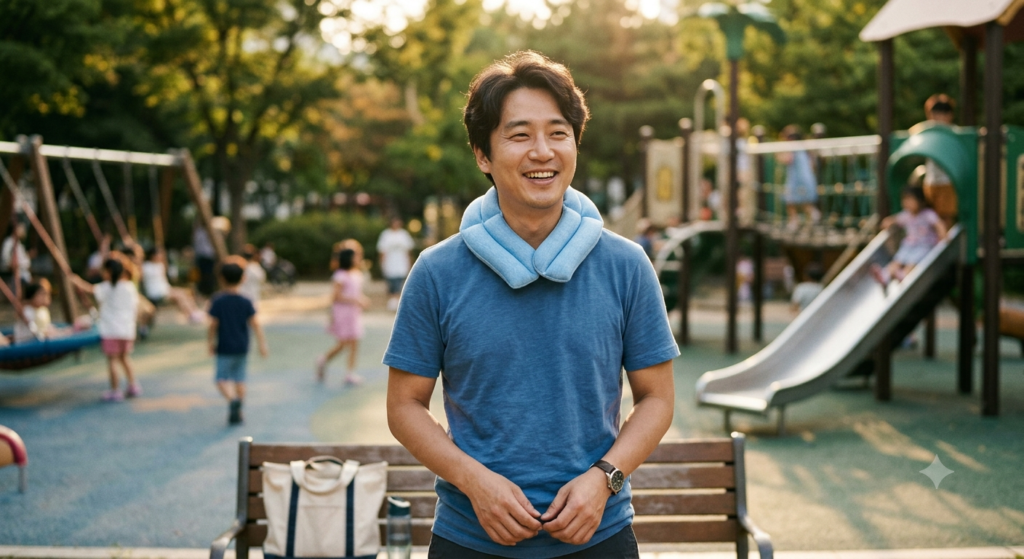
toddler or holding a garden hose. A 넥쿨러 (neck cooler) works differently:
it’s a soft collar filled with a cooling gel or ice pack insert that you
freeze ahead of time and wear against the back of your neck, popular with
people doing physical labor where a fan’s noise or airflow gets in the way.
쿨토시 (cool-toshi, cooling arm sleeves) are UV-blocking, moisture-wicking
sleeves that feel cold to the touch — runners and cyclists wear them
constantly, and so do people working outdoor market stalls in direct sun
all day. Construction sites have gone a step further with 쿨링조끼 (cooling
vests) — a vest with a small battery-powered fan built into the lower
back, channeling air through the fabric against your skin. You’ll see rows
of them hanging in any hardware store by June.
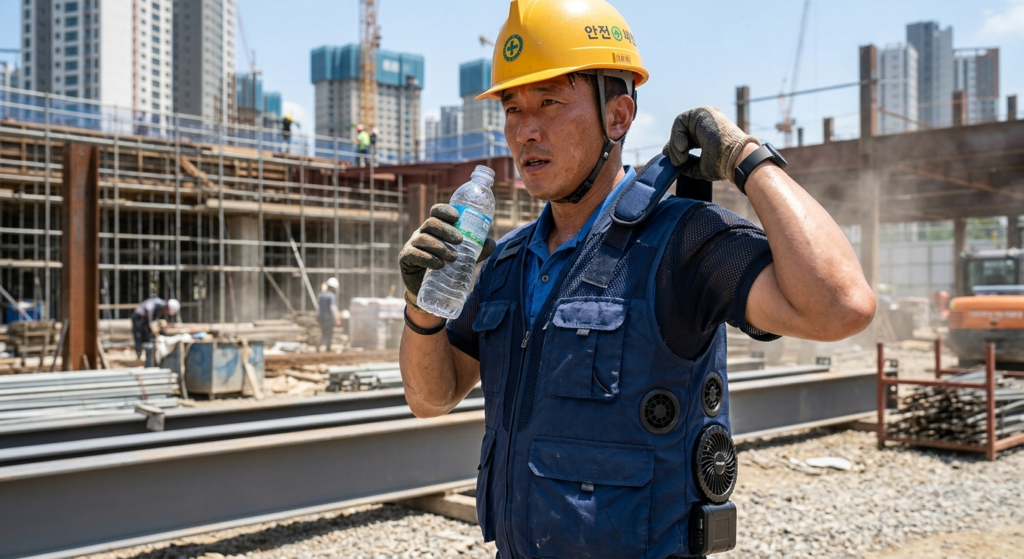
What I like about this category is how specific it is to real situations.
A construction site foreman I’ve seen near our apartment complex wears a
cooling vest under his safety jacket, the small fan humming quietly
against his back. Parents at my daughter’s playground wear neck coolers
while their kids run around at 4pm in August. A friend who does weekend
gardening on his rooftop swears by cooling arm sleeves over sunscreen
alone. None of these are marketed as “wellness” products — they’re treated
as practical, slightly unglamorous tools, the same way you’d think about
work gloves or a good umbrella.
A Culture Built Around Solving Comfort Problems
What strikes me, watching this from the outside now that I’ve lived here long enough to take it for granted, is how much Korean daily life is engineered around small, unglamorous comfort problems. It’s not about luxury — it’s about looking at “I have to be outside in 35-degree heat for the next eight hours” and building a cheap, practical product for it instead of just accepting the discomfort.
That instinct is part of why so many of these gadgets have started getting attention outside Korea recently, especially as summers elsewhere get hotter and less predictable. A neck fan or a pair of cooling sleeves is a small, low-cost fix for a problem that a lot more people are suddenly facing.
I don’t know what this summer looks like for you, wherever you’re reading this from, but if the last few weeks of European heatwave headlines are anything to go by, a lot of you are dealing with heat your homes simply weren’t built for. I’d genuinely like to hear how you’re coping — whether it’s a fan, an ice pack, or just closing the shutters and waiting it out.
If you enjoyed this post, you might also like why Korean apartment complexes have outdoor gyms everywhere — another detail of how Korean apartment life is engineered for everyday comfort — or why recycling in Korean apartments is so complicated, another system that shapes daily routines here. For another side of how Koreans deal with heat and daily comfort, see why Korean saunas are more than just baths.
Inside The Haru Box
The Haru Box explores everyday life in Korea through small cultural details and daily habits. Written by David — Korean-born, raised in England, now living in Yongin, South Korea with his wife and daughter. These are the moments that make life in Korea feel real.