The first time we hosted a jipdeuri (집들이) in our current apartment in Yongin, I nearly tripped over a stack of it in our own entryway. Not flowers. Not wine. Toilet paper. Four different packs, from four different guests, piled by the door like we were bracing for a citywide shortage. My daughter, barely two at the time, tried to climb it like a play set. I was born in Korea but grew up mostly in England, so even though I look like I should know this stuff, this particular custom skipped me entirely. My mother-in-law just laughed when I asked why nobody brought a card. “That’s not how it works here,” she said, setting down pack number five — with a bottle of laundry detergent balanced on top.
Jipdeuri is the Korean tradition of inviting friends, family, and coworkers over after you move into a new home, usually within the first few weeks. The host cooks or orders in, everyone eats together, and guests bring something small for the new place. Somewhere in the postwar decades, toilet paper and laundry detergent became the unofficial default — so standard now that showing up to a close friend’s jipdeuri without one can actually feel a little awkward, like turning up to a birthday party with nothing at all.
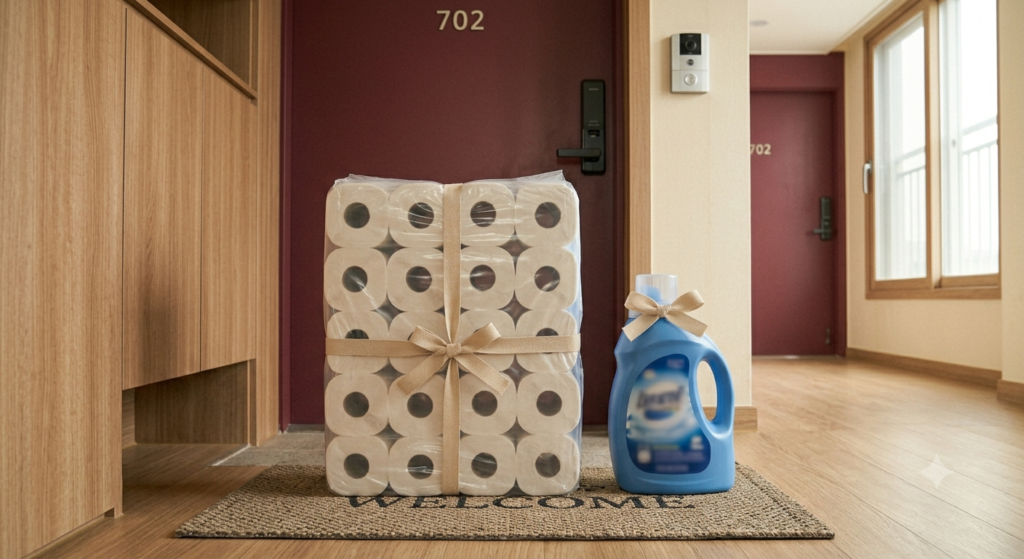
Toilet Paper: Wishing You a Smooth Life
The logic is simpler than it sounds. A roll of toilet paper (휴지, hyuji) unwinds in one long, unbroken sheet — and in Korean, “things going smoothly” is often described with the same word used for something unrolling: sul-sul (술술). Give someone a roll of toilet paper at their new home, and you’re wishing that their life there unfolds just as easily — good health, steady luck, nothing snagging along the way. It’s less a gift than a small blessing you happen to also be able to use in the bathroom the next morning.
Laundry Detergent: Wishing You Wealth
Detergent (세제, seje) works on the same principle, just with a different image. Add it to water and it foams — and that foam, piling up and multiplying, stands in for money growing. Giving detergent is a quiet way of saying “may your wealth pile up the way these bubbles do.” Paired with the toilet paper, the two gifts cover both bases: a smooth life, and a prosperous one.
Why Practical Still Wins
There’s a less poetic reason these two items stuck around: they’re impossible to get wrong. Nobody’s toilet paper goes bad in the cupboard. Nobody minds owning three bottles of the same detergent. When five guests all show up with the same gift, nobody feels embarrassed — everyone just laughs about it, the way we did that first jipdeuri. In a culture that also loves a well-chosen, symbolic gift, toilet paper and detergent are the rare option that requires zero deliberation and is genuinely guaranteed to get used.
What’s Changing in 2026
Walk into any Korean lifestyle blog or YouTube “housewarming gift” list published this year and the toilet paper and detergent are still there — but they’re sharing space with diffusers, scented candles, small potted plants, and mood lighting, especially for gifts aimed at studio apartments and one-person households, which now make up a growing share of new movers in Korea. Among younger, style-conscious friend groups, showing up with the same two items everyone else brought can feel a little unimaginative, so people are branching out — a nice candle instead of a fifth roll of toilet paper, a small cash envelope for a close friend instead of another bottle of detergent. But for parents, older relatives, and anyone hosting a mixed-generation crowd, toilet paper and detergent are still the safe, expected, faintly affectionate default — which is exactly what showed up at our door that day.
The Bigger Picture
What I like about jipdeuri gifts, now that I understand them, is how unsentimental the sentiment is. Korean gift culture doesn’t always separate the practical from the symbolic — a roll of toilet paper can be both a household necessity and a wish for your friend’s good fortune, at the same time, without anyone needing to say so out loud. It’s the same instinct behind the gold ring at a doljanchi or the cash envelope at a wedding: care expressed through something genuinely useful, dressed up with just enough meaning that everyone understands what’s really being said.
These days, when we’re invited to a friend’s jipdeuri, I don’t reach for a card. I grab a pack of toilet paper on the way, maybe a bottle of detergent if I remember, and I don’t think twice about it anymore. By the time our second daughter arrives this September, our own entryway will probably be stacked high again — and this time, I’ll know exactly what everyone’s wishing us.
Inside The Haru Box
The Haru Box explores everyday life in Korea through small cultural details and daily habits. Written by David — Korean-born, raised in England, now living in Yongin, South Korea with his wife and daughter. These are the moments that make life in Korea feel real.
If you enjoyed this post, you might also like how much cash gift money to give in Korea in 2026 — another guide to Korea’s practical-yet-symbolic gift culture — or why Korean babies get a gold ring on their first birthday, another gift that carries more meaning than it looks like.